


 SEND AN E-MAIL TO THIS FELLOW
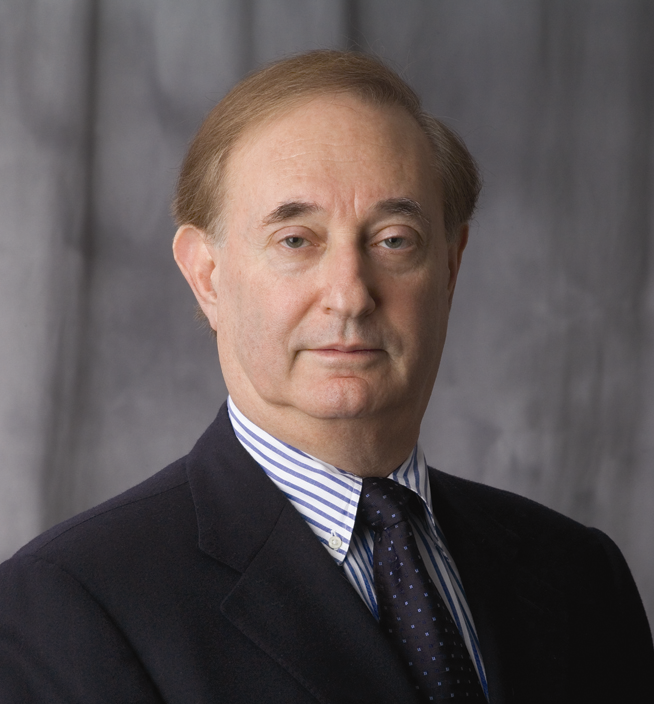
Roger C. Siske
Roger C. Siske, who died in 2006 at the age of 61, was a remarkable attorney, a key influencer in the first generation of Employee Retirement Income Security Act of 1974 (“ERISA”) attorneys who truly set the tone for the manner in which employee benefits law was to be mastered. Roger was inducted in 2000 as a Charter Fellow of the American College of Employee Benefits Counsel (the “College”).
Roger was a proud graduate of the University of Michigan Law School (magna cum laude) in 1969, where the Roger C. Siske Scholarship was later endowed to honor his excellence in character, his lifetime service to the law, and his many valuable contributions to the legal profession. He had earlier graduated from Ohio State University in 1966 with a degree in corporate finance.
Roger spent his entire career with Sonnenschein Nath & Rosenthal LLP (“Sonneschein”) (later, Denton’s) in Chicago, where he developed one of the first nationally recognized employee benefit law practices. He began his career there as a summer associate in 1968 and joined the firm permanently in 1969. Roger regaled many with his stories of the true “front line” practice of law from his tour of duty with the U.S. Army Judge Advocate General’s Corps in Vietnam from 1970 to 1971.
A leader in the true sense of the word in employee benefits law, College Fellow Robert Toth recalled Roger was one of the first to recognize executive compensation as a substantive practice area and was involved in requesting guidance on what became the groundbreaking IRS ruling on automatic enrollment, Rev. Rul. 98-30, that presaged a fundamental practice in retirement plans. He was an early chair of the Employee Benefits Committees of both the American Bar Association (“ABA”) Tax Section and the ABA Business Law Section, where he, along with his colleagues, established much-emulated practice standards. He also chaired the Joint Committee on Employee Benefits (“JCEB”), the Illinois State Bar Association Employee Benefits Section Council, and the Chicago Bar Association Employee Benefits Committee. His counsel was frequently sought--and his influence recognized--by policymakers, key regulators and legislative staff alike.
A frequent lecturer for organizations such as the ABA, Northwestern University School of Law Corporate Counsel Institute, and the New York University Tax Institute, and many others, he was perhaps most widely recognized for his lectures with the American Law Institute (“ALI”)-ABA programs. His annual Advance Law of Pensions sessions with ALI-ABA became an “must attend” program for many practitioners. Obtaining a copy of his and his colleagues’ annual publication of ERISA litigation and developments updates became de rigueur to many, and something which was highly anticipated and regularly referenced.
Though he frequently taught in formal sessions throughout the country, a key part of his professional life focused on bringing others along, all the while holding them to that high standard to which he held himself.
As described by Pamela Baker (also a College Fellow and a longtime law partner with him at Sonnenschein), Roger was “a man of enormous intellect, unerring judgment, uncompromising integrity and fervent devotion to… our profession.” He was a dear friend to many of the leading employee benefit practitioners over time, and a special mentor to young attorneys who later became members of the College as well. Having a noted reputation as a taskmaster, he, himself, was mentored in pension law by the highly esteemed and honored Sidney Perlstadt, who was inducted as a Charter Fellow Emeritus in the College’s inaugural year.
He routinely challenged himself with outrageous physical activities, which included the occasional marathon, triathlon or wet-suit swim in Lake Michigan, and was an avid skier.
Roger’s remarkable life and accomplishments left a significant impact on the practice of employee benefits law.
Photo Source: The Decade Book, American College of Employee Benefits Counsel 2000-2010
